How to Design a Barrier-Free and Inclusive Bathroom
Designing a barrier-free bathroom means creating a space that is safe, comfortable, and usable by everyone, regardless of age or physical condition. It is not only about helping people with disabilities, but about creating an inclusive environment for elderly people, children, pregnant women, or anyone who needs greater safety in the bathroom.
Why create a barrier-free and inclusive bathroom
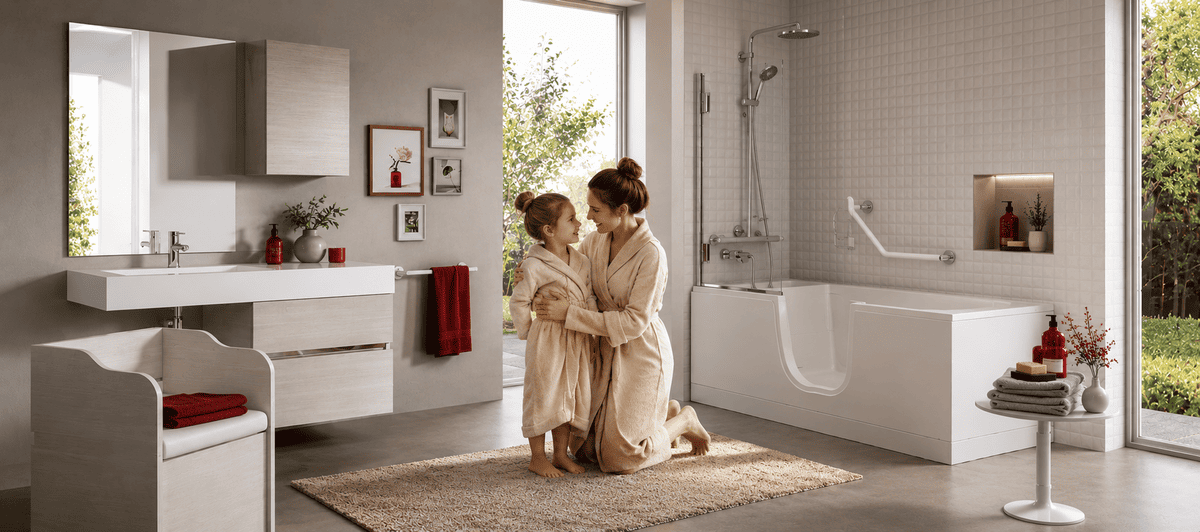
Dignity and autonomy are fundamental aspects for every individual. An inclusive bathroom makes it possible to move independently, without assistance and without risk. When well designed and compliant with regulations, the bathroom becomes a place of well-being and relaxation, where people feel safe and independent. Today, it should no longer be seen as a “clinical” environment, but as a welcoming space that integrates with the rest of the home in an elegant and functional way. It is an investment in the person’s quality of life.
By following a few fundamental principles — adequate space, sanitary fixtures designed and installed according to regulations, non-slip flooring, and proper lighting — it is possible to create an environment that is safe, but also beautiful and pleasant to use every day.
Reference regulations in Italy
In Italy, regulations concerning bathrooms for people with disabilities are based on three fundamental documents:
Ministerial Decree 236/89: Technical requirements for the accessibility, adaptability, and visitability of private buildings.
Presidential Decree 503/96 (24 July 1996): Regulations for the removal of architectural barriers in public buildings, spaces, and services.
Ministerial Circular no. 1669 (22 June 1989): Application guidelines for Ministerial Decree 236/89.
Ministerial Decree 236/89 remains the main regulatory reference for residential construction, defining minimum dimensions for manoeuvring spaces, element heights, and safety devices. In public premises, at least one accessible toilet facility is mandatory.
Space is the key
The first rule for an accessible bathroom is to leave enough space. A wheelchair needs at least 150 cm in diameter to turn comfortably, and a surface area of at least 2 × 2 metres is recommended. The door must be at least 80 cm wide and should preferably open outwards or be sliding, to avoid taking up internal space and to ensure access even in an emergency.
Sanitary fixtures / WC
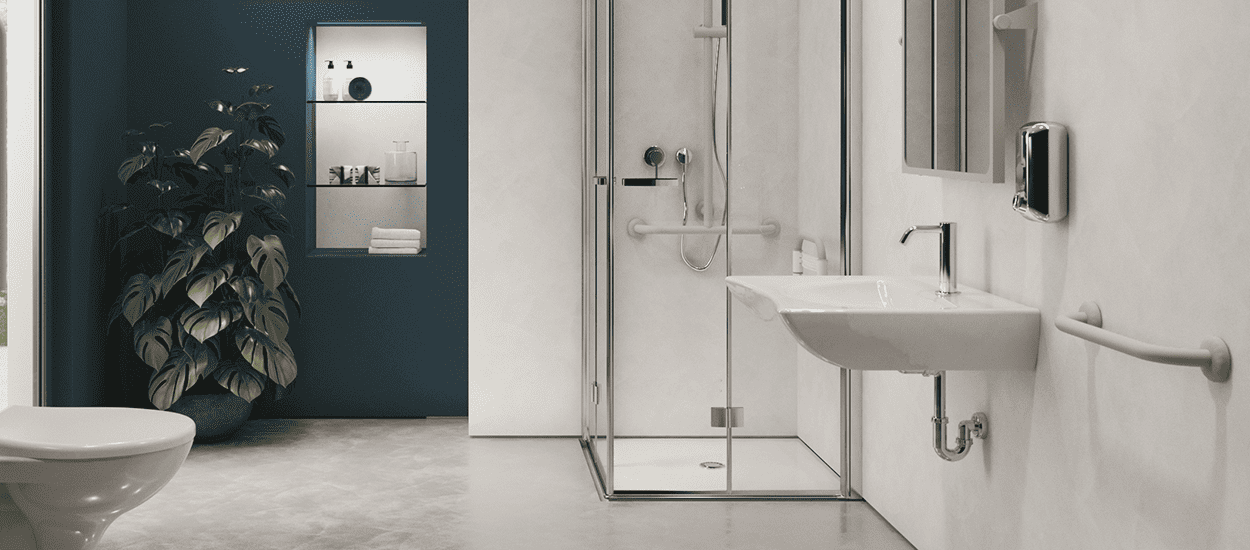
The toilet should preferably be wall-hung, as it is easier to clean and use. The seat height should be approximately 45–50 cm, slightly higher than a traditional toilet, to make transferring from a wheelchair easier. Next to the toilet, it is essential to install fixed safety grab bars or a folding support bar to be used only when needed.
The washbasin
Wall-hung washbasins, without a pedestal underneath, make it easier and more comfortable to approach. The ideal height is 80 cm from the floor, with the space underneath completely free. Long-lever or sensor taps make use easier, while a lowered or tilting mirror ensures excellent visibility even when seated.
The shower
A barrier-free shower is the heart of an inclusive bathroom. The shower tray must be perfectly flush with the floor, eliminating any step that could become an obstacle. Inside, a wall-mounted folding seat should be installed to allow showering comfortably while seated, together with side grab bars for support and safety, and an adjustable-height shower head with a long flexible hose for versatile use.
Tips to ensure safety and comfort
Support grab bars and rails are essential elements for safety and comfort: they should be positioned approximately 80 cm from the floor, both next to the toilet and in the shower area, with a suitable distance of 5 cm from the walls for a comfortable and stable grip.
An alarm bell reachable from both the toilet and the shower is essential for calling for help when needed, especially for elderly people or those with severe mobility limitations.
The floor must be non-slip even when wet, preferably made of ceramic, resin, or PVC with a continuous surface without joints that could trap water or obstruct wheelchair movement. It is best to avoid mats or rugs, as they may move and create hazards.